I recently became a member of librarything.com, the "world's largest bookclub." I'm still exploring the site and setting up an author page, but already I'm impressed by the site and the number of readers and writers who use it. If you're a member, please drop by and say hello!
In related news, ten copies of Dr Olaf are currently available through librarything's Early Reviewers group. I'm pleased that Olaf is listed with such great company, including reader-requested favorites Company of Liars by Karen Maitland, Cul De Sac by Richard Thompson, Extraordinary Engines: The Definitive Steampunk Anthology by Nick Gevers, and Mr. White's Confession by Robert Clark. According to the FAQ, the readers who are selected to receive early review copies are chosen using lecanomancy--I had to look it up--but it involves throwing three stones into a basin and summoning a demon. Sounds fair to me! Though the site promises that other factors are considered as well.
Wednesday, August 13, 2008

Friday, August 8, 2008
Card for Olaf
My mom designed some business cards for Dr Olaf:
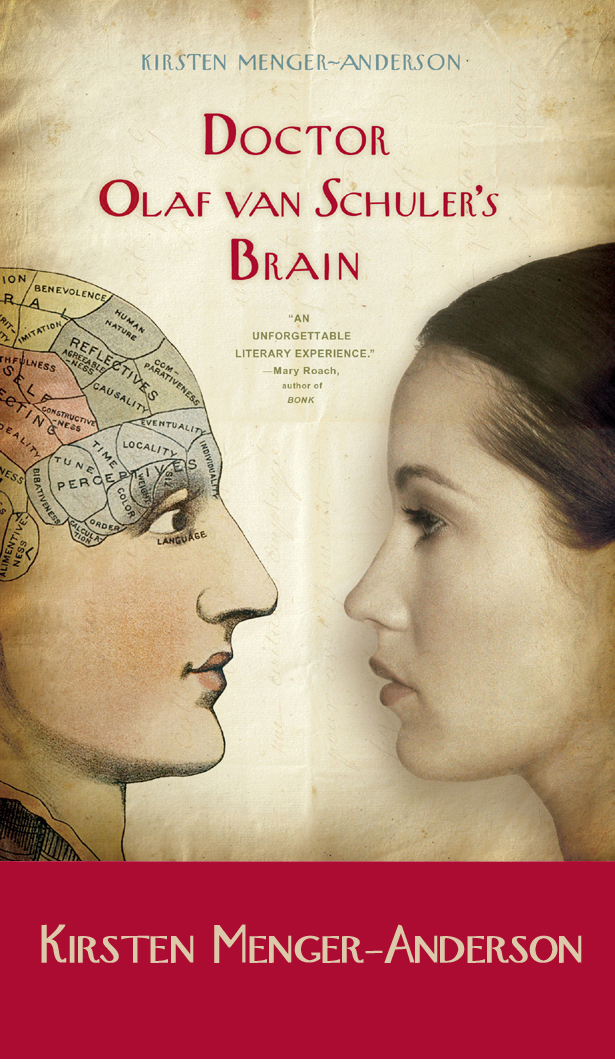
I'm lucky to have a mom with good design sense!
I'm lucky to have a mom with good design sense!
Thursday, July 24, 2008
The Return of the Leech
Back in the day--the 18th and early 19th century, and perhaps as far back as 1000BC--leeches were the cure all, from headaches to hemorrhoids, fever to flatulence and the common cold. Dr. Johann Friedrich Dieffenback (1792-1847), an early practitioner of plastic surgery, even successfully utilized leeches to aid in the reconstruction of the nose of Caroline Rohl, who had suffered from "degenerative scrofula". Dr. R.T Sawyer, founder of what is considered the world's first leech farm, quotes the good doctor in an article that appeared in the British Journal of Plastic Surgery:
Today, leeches ("Hirudo medicinalis") are again being used in medicine, and are especially helpful when reattaching small multi-blood-vessel parts, like ears. In 2004, in fact, the FDA classified leeches as a medical device, the first of its kind: alive.
Live Science reports:
In a recent paper published in the journal Pain, Dr. Andreas Michalsen and his colleagues demonstrate that a treatment of 2-3 locally applied leeches lessened pain in the knees of women suffering from osteoarthritis more effectively than a 30-day course of topical diclofenac, a nonsteroidal anti-inflammatory drug.
Let's hear it for the leech!
Immediately after the transplant the tip of the nose
appeared chalk-white and started to change colour after a
few hours. Therefore, cold compressions were made and 20
leeches were applied to the surrounding area to soften the
developing inflammation, especially around the bridge of
the nose.
Today, leeches ("Hirudo medicinalis") are again being used in medicine, and are especially helpful when reattaching small multi-blood-vessel parts, like ears. In 2004, in fact, the FDA classified leeches as a medical device, the first of its kind: alive.
Live Science reports:
Leech saliva is made up of a potent cocktail of more than 30 different proteins that, among other things, helps to numb pain, reduce swelling and keep blood flowing.
In a recent paper published in the journal Pain, Dr. Andreas Michalsen and his colleagues demonstrate that a treatment of 2-3 locally applied leeches lessened pain in the knees of women suffering from osteoarthritis more effectively than a 30-day course of topical diclofenac, a nonsteroidal anti-inflammatory drug.
Let's hear it for the leech!
Wednesday, July 16, 2008
olaf at the book feast!
My publicist at Algonquin wrote to let me know that Olaf and I were invited to the author feast at the Pacific Northwest Booksellers Association's tradeshow in Portland this September. As soon as I know the exact dates I'll be going, I'll post them to the calendar. I'm excited! From the description, it sounds like I and a number of other writers are invited to answer questions and talk about our work at the book sellers' dinner, table to table rather than before an entire room, which is nice.
Tuesday, July 8, 2008
The Lobotomist
"The Lobotomist," a documentary about Walter Freeman (master of the "ice-pick lobotomy") aired on PBS in January of this year , but I just came across it online. Wow! In addition to introducing Walter Freeman and his methods for curing mental illness, the documentary features testimonials from several patients/their descendants. The daughter of Ellen Ionesco, the first patient to receive a "transorbital lobotomy," describes Freeman: "He looked kindly... very gentle."
Jocelyn Rice writes in Discover:
Freeman refined the technique of Egas Moniz, who in turn, was inspired by the work of Gottlieb Burckhardt, who is mentioned in "The Siblings", one of the stories in DOCTOR OLAF VAN SCHULER'S BRAIN, which, I suppose, is why I'm writing about it here. Check out the documentary if you have a chance. It's broken into short chunks, perfect for those times when one is feeling brain dead...
Jocelyn Rice writes in Discover:
By the mid-1940s, Freeman was touring the country performing dozens of ice-pick lobotomies each day. He used picks from his own kitchen and carpenter’s hammers. Sometimes, for kicks, he’d operate left-handed. Physicians who gathered to watch would throw up and pass out—but patients often got better. Freeman could turn people who were smearing feces on walls and cowering naked under furniture into calm and docile citizens.
Freeman refined the technique of Egas Moniz, who in turn, was inspired by the work of Gottlieb Burckhardt, who is mentioned in "The Siblings", one of the stories in DOCTOR OLAF VAN SCHULER'S BRAIN, which, I suppose, is why I'm writing about it here. Check out the documentary if you have a chance. It's broken into short chunks, perfect for those times when one is feeling brain dead...
Friday, June 27, 2008
First Olaf event!
I recently received news that Olaf and I will be appearing at Keplers in Menlo Park on October 30. Although this may not end up being the *first* time I read, it is the first time I'm officially scheduled to do so. Woo! I have a lot of practicing ahead.
Details:
Thursday October 30, 7:30
Keplers
1010 El Camino Real
Menlo Park, CA 94025
Details:
Thursday October 30, 7:30
Keplers
1010 El Camino Real
Menlo Park, CA 94025
Thursday, June 19, 2008
Searching for God in the Brain
In 1664, Dr. Olaf van Schuler, protagonist of the first story in the book that bears his name, sliced open the heads of pigs, goats, and cows hoping to find the seat of the immortal soul. The soul resided in the brain, he believed, though he did not know exactly where. He poked and probed; he decided upon the pituitary gland.
Today, scientists at the University of Pennsylvania continue to search for the impact of higher forces on the brain. Injecting Tibetan Buddhist monks, nuns, and Pentecostals with radioactive isotopes and then scanning their brains, Dr. Newberg, a professor of radiology and psychiatry, hopes to identify how faith is manifest in brain activity.
According to the St. Petersberg Times:
Does this mean that religious experience is "all in your head?" Dr. Newberg comments on this in the Global Spiral:
Newberg's next book, How God Changes Your Brain, comes out in March.
Today, scientists at the University of Pennsylvania continue to search for the impact of higher forces on the brain. Injecting Tibetan Buddhist monks, nuns, and Pentecostals with radioactive isotopes and then scanning their brains, Dr. Newberg, a professor of radiology and psychiatry, hopes to identify how faith is manifest in brain activity.
According to the St. Petersberg Times:
The frontal lobes got especially busy. They're the part of the brain he calls the "attention area." The meditators had clearly tapped their frontal lobes to focus on their task.
He also saw the thalamus kick in. That's a pea-sized piece of the brain atop the brain stem that, among other things, sends sensory information to the frontal cortex, where much of our heavy thinking happens. Whatever was happening in meditation, the thalamus was making it feel very real.
The surprise was elsewhere, in the parietal lobe, the part of the brain that helps us orient ourselves in relation to things around us. Newberg discovered that the nuns and Buddhists had actually shut down that part of the brain, suspending their senses of space and time. It was then that they entered the peak of their transcendent experiences — altered states of "timelessness and spacelessness."
Does this mean that religious experience is "all in your head?" Dr. Newberg comments on this in the Global Spiral:
Imagine, for instance, that you are the subject of a brain imaging study. As part of this study, you have been asked to eat a generous slice of homemade apple pie. As you enjoy the pie, the brain scans capture images of the neurological activity in the various processing areas of the brain where input from your senses is being turned into the specific neural perceptions that add up to the experience of eating the pie: olfactory areas register the delightful aroma of apples and cinnamon, visual areas perceive the sight of the golden brown crust, centers of touch perceive the complex mix of crunchy and gooey textures, and the rich, sweet, satisfying flavors are processed in the areas responsible for taste. The SPECT brain scan would show all this activity in the same way that it revealed the brain activity of the Buddhists and the nuns, as blotches of bright colors on the scanner's computer screen. In a literal sense, the experience of eating the pie is all in your mind, but that doesn't mean the pie is not real, or that it is not delicious.
Newberg's next book, How God Changes Your Brain, comes out in March.
Subscribe to:
Posts (Atom)

